
Waste sorting at the student residences
Behind the student residence building you will find four separate waste containers: packaging, paper and cardboard, bio-waste, and mixed household waste.
Please make sure to place your waste in the correct container to ensure that as much material as possible can be recycled.
Even one carelessly placed trash bag can contaminate an entire container and make proper sorting impossible. In such a case, the whole container must be treated as mixed waste, and all previous sorting efforts are lost.
Every correctly sorted bag helps protect the environment, reduce waste–related costs, and support a functioning circular economy.
What to keep in mind?
1. In Estonia, it is mandatory to collect bio-waste separately from all other waste types. This is required for several reasons:
- Bio-waste cannot be separated from mixed waste afterwards.
- When mixed with other waste, bio-waste contaminates recyclable materials, making their recycling impossible and increasing the amount of waste that must be burned or landfilled.
- When landfilled, bio-waste produces landfill gas, a potent greenhouse gas that contributes significantly to climate change.
- Bio-waste is a valuable resource. In Estonia it is mainly used to produce compost, returning nutrients to the soil. In the coming years, biogas production is also expected to grow — biogas can be used as vehicle fuel, for heating buildings, and for generating electricity.
2. If you are not sure where an item belongs, you can use the RecycleMore app and its waste scanner to check. The app identifies items based on a photo and tells you exactly which bin to use.
3. If you do not wish to sort all waste fractions separately, then you must still place all bio-waste in the bio-waste container, as mixing it with other waste is prohibited and causes significant environmental harm.
Other waste types may be placed in the mixed household waste container if necessary, but we encourage you to sort packaging and paper/cardboard whenever possible to support recycling.
Below you can find detailed information about each waste category — what belongs where and how to sort it properly.
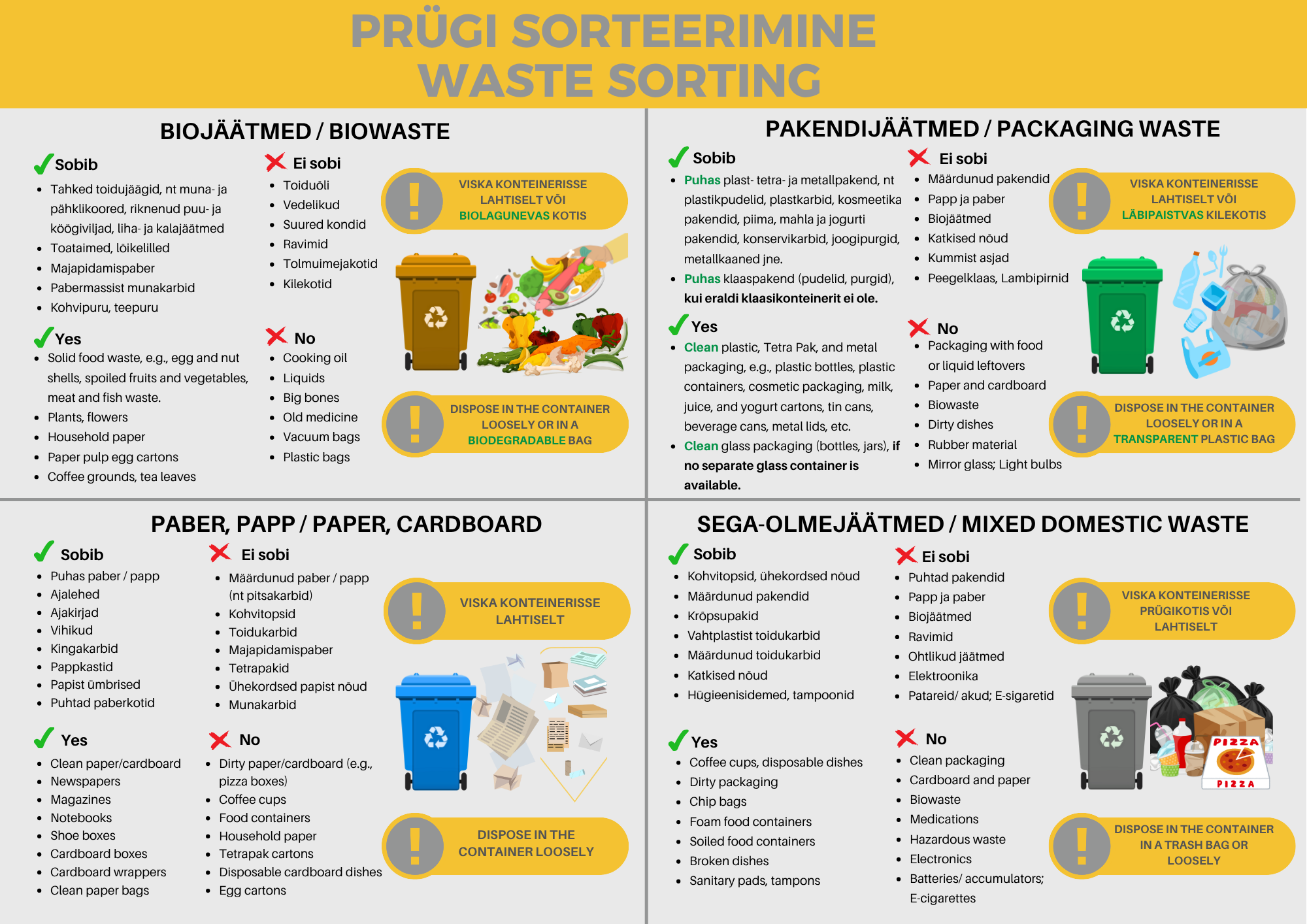
Mixed waste includes all other waste that cannot be sorted separately. All remaining rubbish that is left after sorting recyclables can be disposed of in the mixed waste container.
Suitable for: drink cartons, metal packaging, glass packaging and plastic packaging.
Packaging must be empty, clean, and dry, and it should not contaminate other waste.
Please place packaging in the container either loose or in a transparent plastic bag.
This container is for clean paper and cardboard, such as newspapers, magazines, notebook pages, cardboard boxes, and paper bags.
Important:
- Paper and cardboard must be completely clean — do not place dirty or greasy items, such as used pizza boxes, inside.
- Flatten or break down large cardboard boxes before placing them in the container to save space.
Why sort paper and cardboard separately?
Paper and cardboard are easy to recycle when they are clean and dry. By sorting them separately, you help save natural resources, reduce waste going to landfills, and make it possible to produce new paper and packaging materials from recycled fibers.
Biowaste consists of decomposable and compostable food and kitchen waste.
Biowaste must be collected separately from other waste!
This is important because biodegradable waste can be reused – for example, to produce compost or biogas.
Items suitable for the biowaste container include:
- Food waste such as meat and fish scraps, fruit and vegetables (including peels), bread, pastries, semi-prepared foods, baked goods, cheese, butter, margarine, and other solid food residues.
- Household paper, paper napkins, coffee grounds, and paper filters.
- Houseplants and cut flowers.
- Teabags, only if they are made of 100% biodegradable material.
Please note:
- Ordinary plastic bags are not suitable for biowaste — they belong in plastic packaging recycling.
- Empty food packages should go into metal, plastic, cardboard, or glass packaging recycling, depending on the material.
In the Student Hostel, each apartment has a green biowaste collection bin.
You can collect biowaste in a biodegradable bag or paper bag — in this case, you can throw the entire bag into the outdoor biowaste container.
If you use a plastic bag, you must empty the biowaste loosely into the outdoor container and then dispose of the plastic bag separately in the packaging recycling bin.
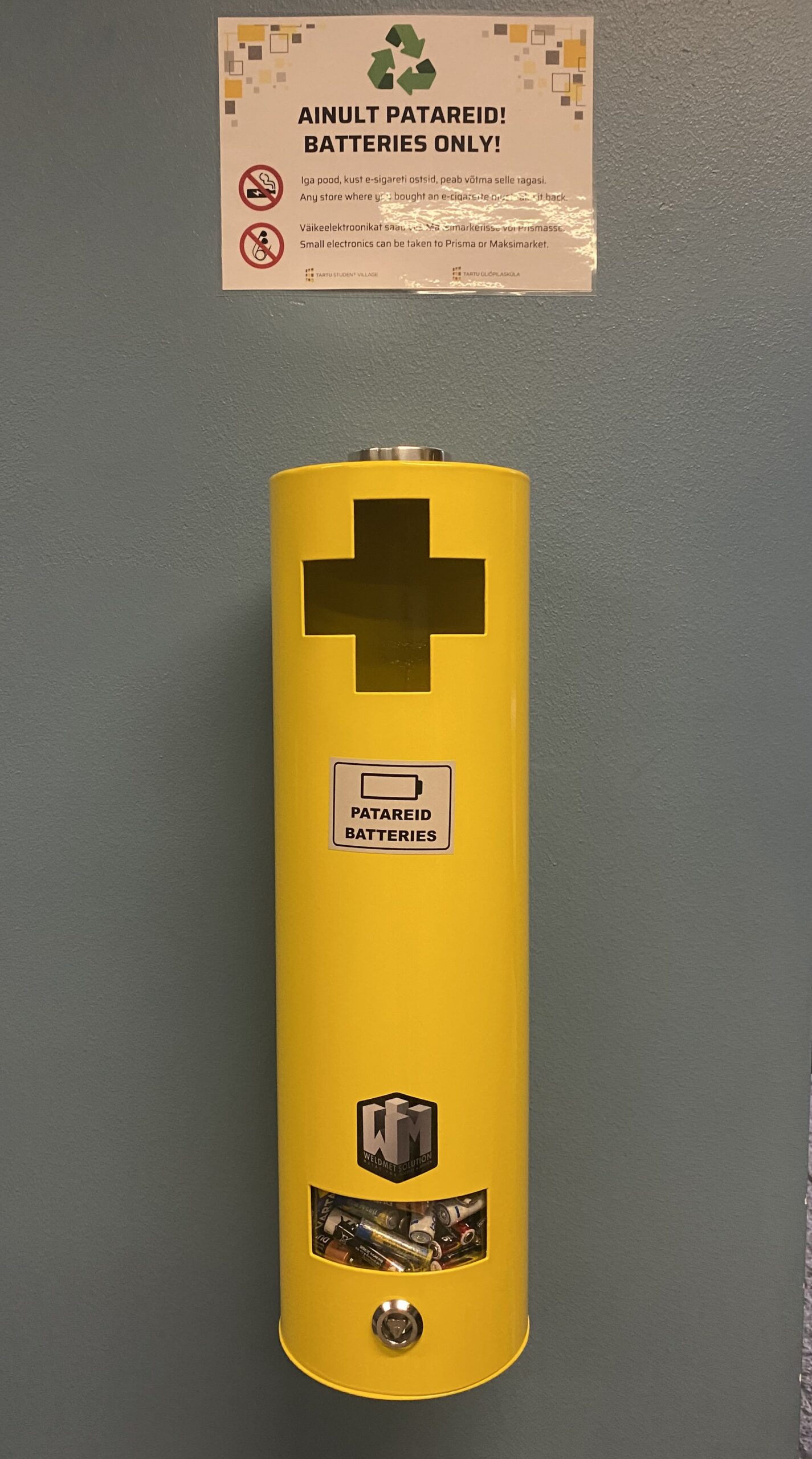
Many components of old batteries are toxic and pose a hazard to our natural environment and our health. You can take your old batteries to the designated box at your residence hall lobby.
Recycling bottles/cans
Estonia has a refundable packaging deposit system. You can return the plastic, glass and metal packaging’s of water, carbonized drinks, beer, cider, perry and alcohol beverages to the vending machine to get your deposit back. More information is available HERE.
Second-hand
Clothing and other things you might not need anymore can be offered to other tenants via Facebook groups created for each residence hall.
You can also donate your things to Uuskasutuskeskus.